The Flood

In the early hours of Friday, November 4, 1966, the Arno came over its banks and into the center of Florence. By mid-morning the water had reached the Piazza del Duomo. In the Santa Croce district it stood higher than a man's head - at its deepest, about 6.7 meters (22 feet). It carried mud, sewage and heating oil into churches, libraries, workshops and homes, and when it drained away it left an estimated 600,000 tons of mud behind. Thirty-five people died. The damage to the city's art, books and archives was immense, and it made the flood an international event.
A river with a history
Florence has always lived with the Arno. The great floods of 1333 and 1557 are remembered in carved plaques on the city's walls - in Via San Remigio, a sculpted hand marks the level reached in 1333 - and the city flooded seriously again in 1844. The risk was known. What was missing in 1966 was any system to measure the river's rise upstream and warn the people downstream in time.
The rain, and the dams
The autumn of 1966 had been wet across Tuscany, and the rain in the days before the flood was relentless - Italy's Civil Protection Department describes some ten days of heavy rain before the river broke. By the night of November 3 the ground of the Arno basin was saturated and could absorb nothing more. The river first overflowed upstream, in the Casentino and the upper Valdarno, and the flood wave moved down the valley toward the city.
Above Florence, the Levane and La Penna reservoirs on the Arno were opened to relieve the pressure on the dams. Whether those releases were handled as well as they could have been - and how much they added to the peak that reached Florence - has been argued over ever since. No one was ever held legally responsible, and the question has never been settled.
The night
November 4 was a national holiday, the day of the Armed Forces and of National Unity. Shops and offices were closed and most people were at home asleep - which is one reason, historians generally agree, that the death toll was not far higher.
There was no public warning. Through the night, a few people raised the alarm on their own. A night watchman on the Ponte Vecchio telephoned the goldsmiths whose shops line the bridge, and some of them came down in the dark to empty their shops before the water reached them. Dante Nocentini, head of the ANSA news agency's Tuscan bureau, sent one of the first alarms out over the teletype that night, warning that the flood crest was advancing on the city.
Between about two and four in the morning, overloaded sewer lines began to burst. The river came over its banks east of the city and then into the historic center, beginning in the streets around Santa Croce. Around seven, the embankment wall at Piazza dei Cavalleggeri gave way, and the full force of the river poured into the National Central Library and the Santa Croce neighborhood. By about nine the water was in the Piazza del Duomo. Parts of the Lungarno Acciaiuoli collapsed. At the Murate prison in Santa Croce, residents took in prisoners to save them; one young inmate drowned.
Italy's Civil Protection Department describes a wave about three meters high moving through the streets at some 60 kilometers an hour. At its peak the river was carrying an estimated 4,100 cubic meters of water per second - roughly twice what the channel through the city, at the Ponte Vecchio, could pass.
How high the water rose
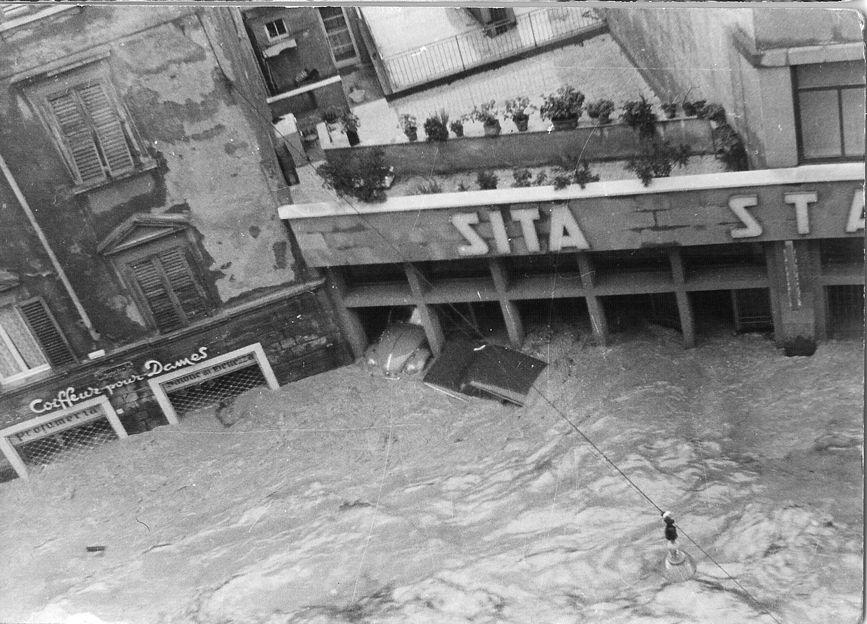
Depth varied with the ground. The figure most often cited for the deepest flooding is about 6.7 meters (22 feet) in the Santa Croce area. The plaque on Via dei Neri, near Santa Croce, records 4.92 meters at that spot. Plaques recording the 1966 level - often placed beside the marks for 1333 and 1557 - can still be found on walls across the center, and are worth looking for: standing under one is the quickest way to understand what happened.
Florence itself was cut in two. Telephone and power failed. The higher ground of the Oltrarno hills was spared, while the low-lying districts - Santa Croce, San Frediano, the streets toward the station - took the worst. Across the city, an estimated 20,000 cars were swept away or wrecked, and heating oil from thousands of basement tanks, filled for the winter, coated everything the water touched.
The toll
The water began to fall on the evening of November 4, and by November 6 the river had withdrawn. For years the number of dead was uncertain and often exaggerated. In 2006, for the 40th anniversary, the official list the Prefect of Florence had sent to the Interior Ministry in December 1966 was made public: 35 dead - 17 in the city of Florence and 18 elsewhere in the province, among them small children. Many of those who died in the city were elderly people alone in ground-floor homes. The flood also struck the towns along the Arno below Florence, from Campi Bisenzio to Empoli and beyond, and nearly 20,000 families were flooded out, some 4,000 of them left homeless.
The cultural losses are described on our pages on art restoration and the mud angels, the volunteers who came from around the world to help.
What changed
The flood exposed the fact that Italy had no national system for responding to a disaster. Soldiers, firefighters and police worked heroically, but without coordination; according to the Civil Protection Department, it took the government six days to organize a structured relief effort. The first national framework for disaster relief - Law 996 of 1970 - followed directly, and for the first time it formally recognized the role of volunteers. Today's Italian Civil Protection system traces its origins to that law.
Could it happen again?
The honest answer is that Florence is safer, not safe. The riverbed under the Ponte Vecchio has been lowered to increase the channel's capacity, work continues on retention basins upstream, and the river is now monitored with a forecasting and warning network that did not exist in 1966. But engineers have said that protecting the city against a repeat of 1966 means being able to hold back roughly 35 million cubic meters of water upstream, and that work is not complete. Much of the historic center is still classified as being at medium flood hazard.
See also: the 60th anniversary, November 4, 2026.
Last update:
About
Florence Flood has documented the great flood of Florence of 1966 since 2006, and helped bring some of the only known color photographs of the flood to the city archive of Florence. More about this site